Kensington Banks

Community Court Recycling

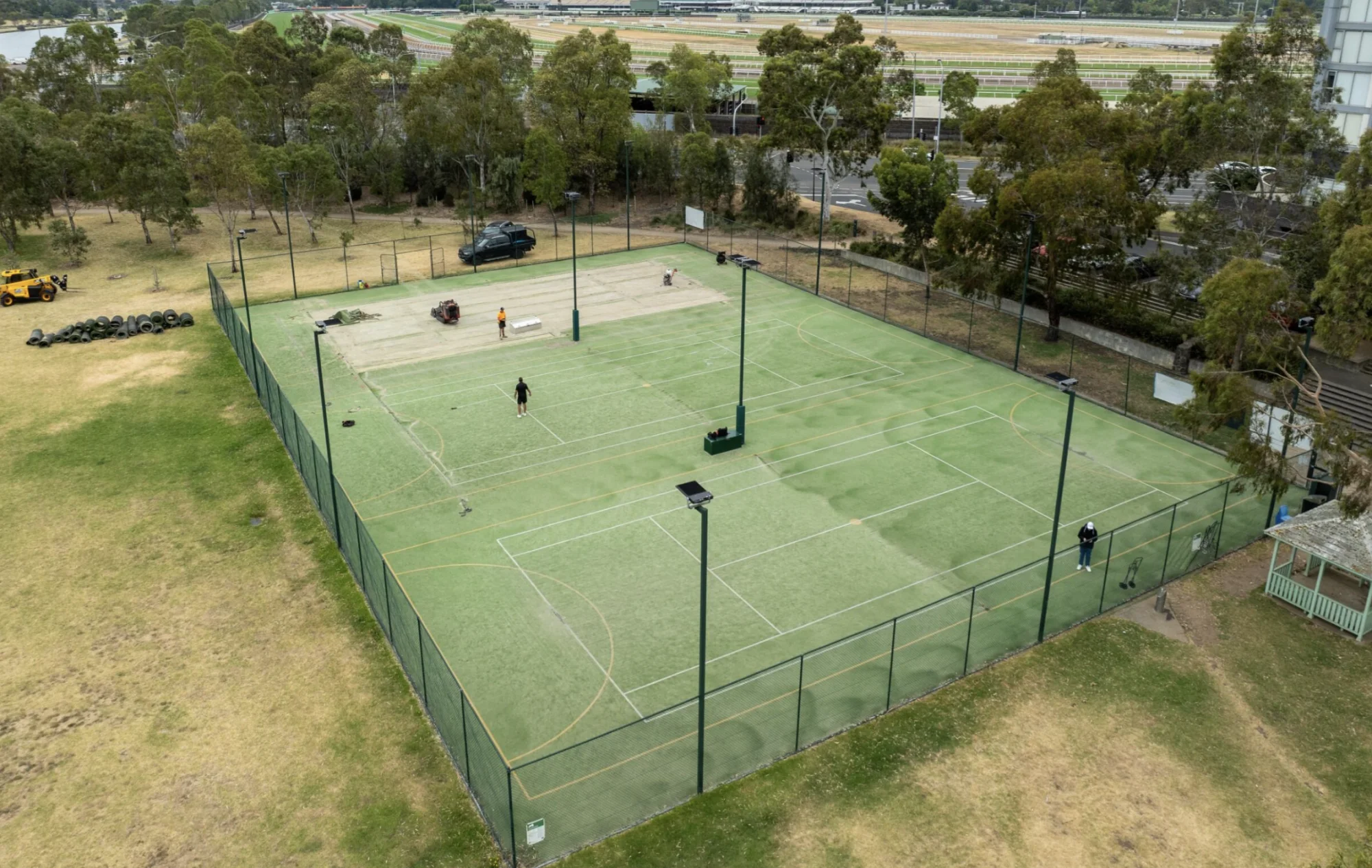
RE4ORM synthetic turf recycling – Aerial view of a fenced outdoor sports court in Kensington Banks, marked for multiple games, surrounded by grass and trees. A few people are on the court, with some sports equipment visible in the area.
Client:City of Melbourne
Delivery Partner:Tuff Turf
Project:Kensington Banks Tennis Courts
SECTOR: Tennis
ABOUT THE PROJECT

3 end-of-life synthetic tennis courts recycled for the City of Melbourne

Kensington Banks Tennis Courts are a well-used community tennis facility in Melbourne’s inner west. Home to a local tennis club and daily coaching programs, the courts are a key piece of grassroots sporting infrastructure in the area.

After approximately 20 years of use, the existing synthetic surfaces had reached the end of their service life. The City of Melbourne, supported operationally by Serco, initiated a renewal process and engaged Tuff Turf to deliver the upgrade. Encouragingly, the City of Melbourne chose to include recycling as part of the project scope – ensuring the old courts would not simply be sent to landfill.

1,670 m²

synthetic tennis courts

33T

of material recycled

25T

of sand infill recovered

12.3T

CO₂e emissions avoided

The Challenge

While the uplift itself was straightforward, access to the site required careful planning.

Although located near the frontage of Kensington Banks, the courts sit below street level on a slope. There is no direct truck access from the main road.

Instead, access required:

  • Routing trucks underneath a bridge
  • Travelling along the Maribyrnong River corridor
  • Navigating through an active public park
  • Driving along shared footpaths with controlled traffic management
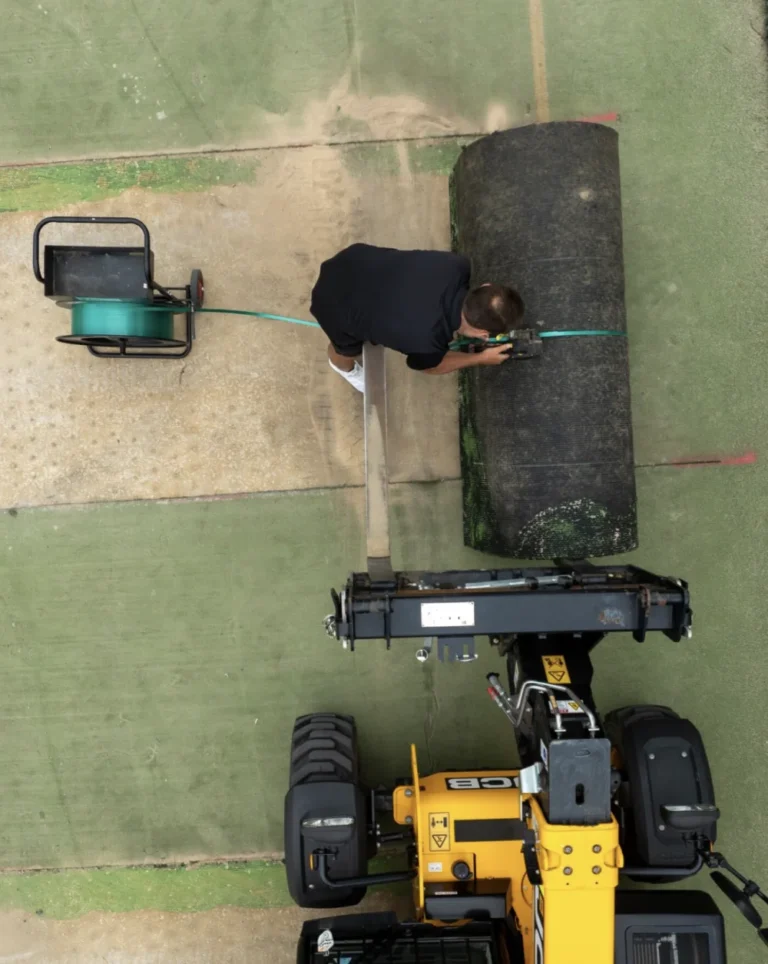
RE4ORM synthetic turf recycling – A person secures a strap around a large rolled-up piece of artificial turf next to a reel at Kensington Banks, while a yellow construction vehicle prepares to lift the roll on a partially tarmacked surface.
The Solution

A lean, access-appropriate uplift strategy

Given the site constraints, tray-body trucks were selected instead of semi-trailers — allowing safe manoeuvrability through the park and controlled loading within tight access points.
RE4ORM synthetic turf recycling – Three black lines—one wavy, one with connected semicircles, and one with circles—symbolise the cycle of recycling benefits and highlight a positive environmental impact on a clean, white background.

Complete Court Uplift

RE4ORM completed the full uplift of three synthetic tennis courts safely and efficiently.

RE4ORM synthetic turf recycling – Two overlapping sets of concentric circles, each with three rings, create a central intersection—visually representing "how we do it" through thoughtful design and clear structure.

Machinery-Ready Roll Preparation

Courts were precision-cut and rolled to meet RE4ORM’s recycling specifications.

RE4ORM synthetic turf recycling – Four simple black shapes on a white background: a circle, a square, a rounded-corner square, and an upside-down triangle arranged in a 2x2 grid.

Custom Transport Logistics

Tray-body trucks were used to suit site access and streamline load-out.

RE4ORM synthetic turf recycling – A person sits cross-legged on the floor, meditating with eyes closed and hands resting on their knees. Nearby, a relaxed cat lounges as decorative plants and a lamp highlight the peaceful scene, reflecting the recycling benefits for a serene home environment.

Managed Parkland Access

Traffic was carefully controlled through the active parkland to minimise disruption.

RE4ORM synthetic turf recycling – A hand-drawn black circular arrow, reminiscent of the energy at Kareela Oval sports ground, with two arrowheads—one at the top right curving down and one at the bottom left curving up—forms a continuous loop on a white background.

Full Material Recovery

All turf was transported to RE4ORM’s facility for complete recycling.

Planning a Tennis Court Renewal?

Whether it’s one court or an entire precinct, RE4ORM provides a simple, compliant alternative to landfill - no matter the site constraints.